Instrument Safety · The Sterile Standard
Why Sterilisation Can Fail
A completed machine cycle does not automatically prove that every instrument is sterile. Failure can begin before the steriliser starts—through incomplete cleaning, unsuitable packaging, incorrect loading or the wrong cycle—and can continue afterward through wet packs, damaged seals or unsafe storage. A reliable process controls and records the entire journey.
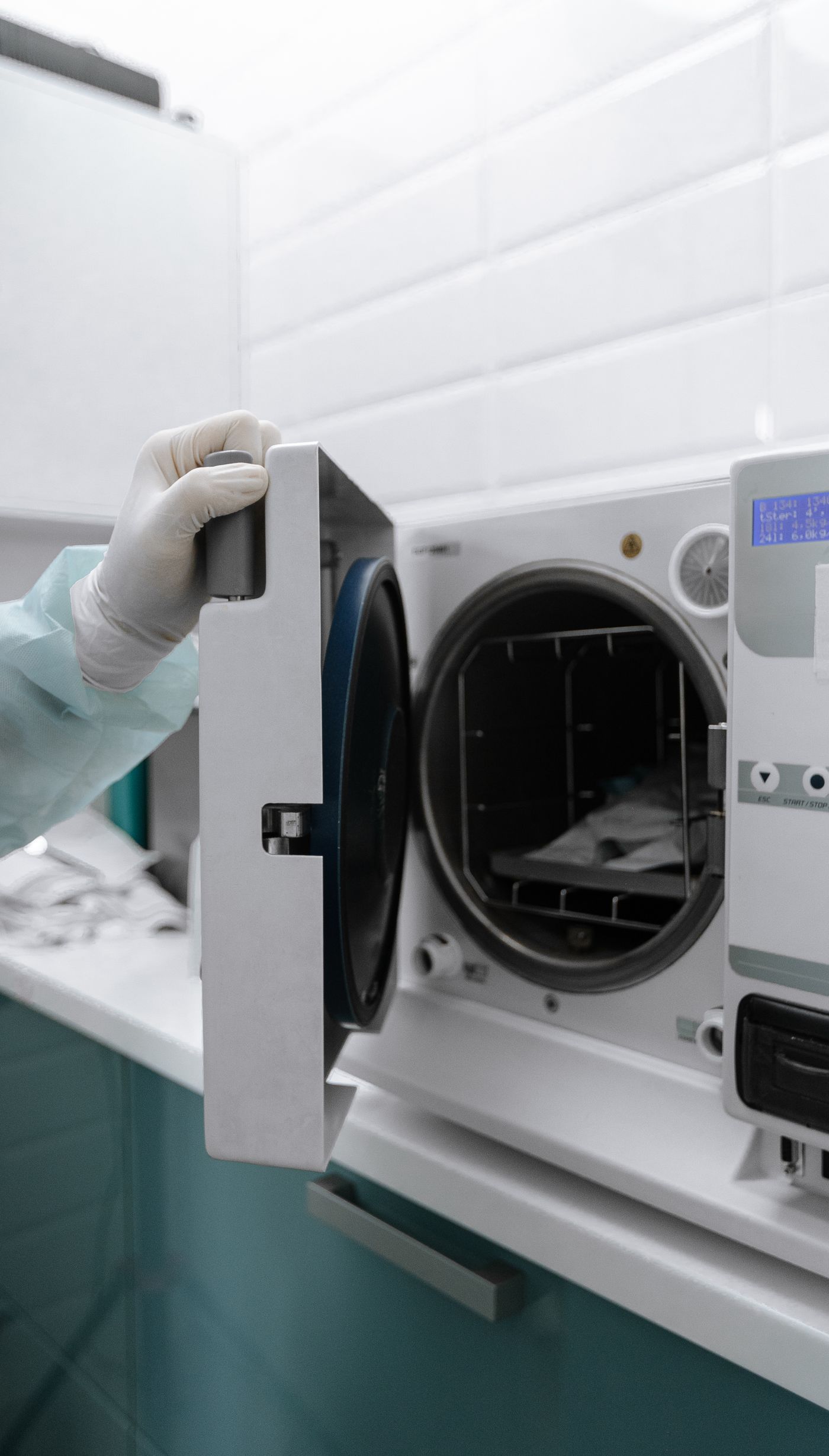

The central principle
Sterilisation is a controlled system—not simply a hot machine
Sterilisation destroys all viable microbial life when a validated process reaches the required conditions throughout the load. Those conditions depend on the selected method, equipment, instrument design, packaging and loading pattern.
If residue blocks contact, air remains trapped, steam or sterilant cannot circulate, exposure parameters are not achieved, or a processed pack becomes wet or torn, the instrument may not be safe to release.
The failure investigation
Five points where the process can break
Before packaging
Cleaning was incomplete
Soil, oils, product, rust or moisture remained on the instrument.
During preparation
Packaging was unsuitable
The pouch, wrap, seal or container did not match the sterilisation method.
Inside the chamber
The load blocked circulation
Overloading, stacking or closed hinges prevented complete sterilant contact.
During the cycle
Required parameters were not achieved
Time, temperature, pressure, sterilant concentration or equipment performance was inadequate.
After the cycle
The pack was compromised
Moisture, tearing, puncture, an open seal or unsafe storage allowed recontamination.
Failure point one
The steriliser cannot correct incomplete cleaning
Soil blocks sterilant contact
Skin, nail dust, oils, adhesive and dried product can protect microorganisms beneath them.
Hidden surfaces remain inaccessible
Hinged tools should be opened or disassembled as instructed so cleaning reaches every surface.
Packaging and processing may be affected
Items should be rinsed, inspected and dried according to the validated preparation procedure.
Corrosion and cracks retain contamination
Damaged items may be difficult to clean and may need repair or removal from service.
Failure point two
A sterilisation pouch has several jobs
Packaging must permit the sterilising agent to enter, allow drying, maintain the processed item’s integrity and support aseptic opening. It must also be approved for the selected sterilisation method.
Package inspection
Do not process or release a compromised pouch
Not designed for the cycle
Packaging may block sterilant entry, fail under heat or prevent adequate drying.
Circulation is restricted
The instrument may press against seams or prevent sterilant from reaching every surface.
Sterility cannot be maintained
A gap, fold or channel through the seal compromises the protective barrier.
The pack is no longer protected
Sharp instrument tips and careless handling can damage packaging before or after processing.
Failure point three
A crowded chamber can create a failed load
The validated loading pattern and steriliser manufacturer’s instructions determine how packages, trays and instruments are positioned.
Failure point four
The correct cycle must match the load
Wrapped instruments, unwrapped items, porous loads, solid instruments and different steriliser technologies may require different cycles. Selecting a faster or familiar setting without confirming compatibility can produce an unprocessed load.
Never substitute remembered temperatures or times for the steriliser and instrument manufacturers’ instructions. The full programmed exposure and drying stages must complete without interruption.
Sterilisation assurance
Three monitor types answer different questions
Mechanical monitoring
Did the machine report the required parameters?
Review gauges, displays, printouts or digital records for time, temperature, pressure and cycle completion.
Check every load.Chemical monitoring
Did the sterilising conditions reach the package?
Use an internal indicator in each package and an external indicator when the internal result cannot be seen from outside.
A colour change does not prove sterility.Biological monitoring
Could the cycle inactivate resistant test spores?
Use biological indicators at the frequency required by the equipment instructions, regulation and written quality-assurance plan.
This directly challenges the sterilisation process.Do not read one indicator as the whole answer
Every monitor has a limit
Shows the machine’s reported conditions
It does not confirm that sterilant reached every surface inside every package.
Shows exposure to selected conditions
It does not prove that all microorganisms were destroyed.
Tests the lethality of the process
It does not correct poor cleaning, damaged packaging or unsafe storage after the cycle.
Failure point five
A wet package must not be released as sterile
Moisture can allow microorganisms to move through packaging and can weaken the sterile barrier. Wet packs may result from overloading, incorrect positioning, interrupted drying, inadequate drying time, equipment problems or removing the load too soon.
Do not dry a wet pack with a towel or place it into storage. Quarantine it and reprocess the instrument through the complete approved sequence.
Before release
Inspect the load while the evidence is still available
Required parameters were achieved
The display or printout shows a complete cycle without alarms or unexplained interruption.
Expected results are present
External and internal chemical indicators changed as required by their instructions.
Every pouch is dry and intact
No moisture, open seals, punctures, tears or crushed areas are present.
The load can be identified later
Required load, date, operator, cycle and monitoring information is complete.
When a monitor fails or the cycle is questionable
Quarantine first. Investigate before release.
Stop using affected instruments
Keep the load and related packs separate from released stock.
Review the cycle evidence
Check alarms, parameters, load arrangement, packaging, indicators and operator notes.
Check the steriliser and procedure
Confirm utilities, maintenance status, cleaning, cycle selection and loading practice.
Repeat testing as directed
Follow the manufacturer, regulator and written response procedure before returning equipment to service.
Assess earlier loads when required
A confirmed failure may require tracing, recall, client-safety review and incident documentation.
Machine reliability
A steriliser needs documented maintenance
Chamber cleaning, gasket inspection, drain care, water-quality requirements, calibration, servicing and performance testing should follow the manufacturer’s schedule.
Repeated alarms, unusual cycle times, damaged seals, poor drying or inconsistent indicator results should not be treated as normal inconveniences.
Chamber, drain, water and visible condition
Manufacturer service and replacement parts
Required tests after installation, repair or relocation
Date, action, result and responsible person
Sterile storage
A successful cycle can still be undone afterward
Store processed packages in a clean, dry and protected area away from used instruments, splash, dust, crushing and unnecessary handling.
Package integrity—not appearance alone—determines whether an item remains suitable for use. A torn, wet, opened or contaminated package must be reprocessed.
Final decision